Wednesday, May 28, 2014

Day One of SIT Classes- Disabilities, Youth Empowerment and Monitoring & Evaluation

*Note: this blog was written by me on February 1st, 2014. I ended up writing way more about each of these organizations that I had intended, and then I got hung up on writing more about each one and basically put my blog on hold. I started many more blog entries as the months passed, so my hope is to complete the blog entries post-trip and to put them here belatedly. I love sharing my story, and I apologize for the delay. I hope you still enjoy, and please feel free to ask me any questions or share your thoughts!

Goutamji told me a story about the Hindu god Vishnu, who volunteered to swallow an entire sea of poison in order to save a group of gods, leaving his throat bright blue. The way Goutamji interpreted it is that there is poison in the world, along with all of the good things. You should not swallow the poison, but you should hold it in your throat and learn from it. I think that's what I'm doing here in India—taking my observations and merely holding them and studying them to find out more about development, about life in India, about myself.

I could write for days on each organization we met, but I'll briefly describe each one instead so you're not completely sacked with information (I took pages of notes, if anyone's interested, or go check out the organizations' websites!). Some organizations left larger impressions on me than others, as you'll soon see.

It all started on January 13th We met first with Merry Barua, the founder of Action For Autism (AFA). Her son, now 30, is autistic. When his symptoms were showing themselves, though, “autism” was not even a concept in India. Imagine not even having the words to describe your child's condition! (Plus, many people in India look at a disability as a result of bad karma by the person who is disabled or even a family member, so people with disabilities and their families are very often shunned). He was misdiagnosed with behavioral issues and thus his symptoms went untreated, becoming worse. She took it upon herself to start a school specifically for people with autism. This led to a massive campaign to raise awareness about autism in India, and the establishment of partnerships with top researchers as far as Chicago and Denmark to train doctors, educators and parents on what autism is and how to support a person with autism. AFA is now heavily involved with drafting and passing legislation regarding people with disabilities. They are truly doing some amazing things regarding social innovation and human rights.

The activities of Action for Autism
Activities designed specifically for adults with autism.

Emilyji trying out the handloom that adults
with autism use to produce sellable crafts.
Supplies for adults with autism to make sellable handcrafts

Seems rudimentary, but this classroom setup is based on research and is extremely advanced for developing countries in that in recognizes the need for organization and individualized education for students with autism.
This kind of thing reminded me of my classroom in a way!

Textured mats for kinesthetic learning at Action for Autism 


Monday afternoon we met with Vimlendu Jha, the young founder of Swechha, which means “We For Change.” He originally started “We For Yamuna” to get the youth of Delhi to rally together to raise awareness and bring about government action regarding the ridiculously polluted Yamuna River. Delhi's primary drinking water source is clean until it reaches the capital, whose well-educated governing and scholarly classes leave it in an absolutely wretched state. We For Yamuna transformed, over time, into Swechha, due to the realization that government apathy and inaction were such huge issues (it's interesting to note that the Indian government can get an incredibly sophisticated metro system built in just a few years, but it won't put in the effort to get a major water source cleaned up). Today, Swechha continues its environmental advocacy work, but it also works to empower the Indian youth to become change-makers. Vimlendu talked to us about social entrepreneurship, and how it finds itself as an balanced alternative between the two extremes of profit-driven business and donation/grant-dependent NGOs. I was glad we were able to get such a firm foundation in social entrepreneurship so early.

Vimlendu Jha gave us an awesome lecture about social entrepreneurship from his vantage point as a social entrepreneur in India

Our third speaker that day was Noor Parvin Aboobacker from BBC Media, who spoke to us about monitoring and evaluation in the context of social entrepreneurship and social innovation. In order for growth to be evident, there has to be evidence! Baseline surveys, midway surveys, and end surveys must be administered to understand the situation before, during and after services are rendered. This should be used for obtaining funding, but more importantly it should be used to drive strategy. It's crazy how much teaching has already taught me about the world, because this is the same kind of thing we had to do with our students to ensure that they were actually making progress in the areas they needed the most. Unfortunately Noor's presentation did not impress me too much, but the topic of Measuring and Evaluation has reoccurred to me several times, and it is not one to be ignored as I continue my plunge into the world of development.


Alright, so that about wraps up my FIRST day of classes haha! I'll write another one to cover some more organizations—we really met some amazing people in India, and I would love for my friends and family and others to be in the know about efforts to improve lives in India. 

Friday, January 31, 2014

Laying the Groundwork

Goutam-ji says: “Since India is a country of oral tradition, I always give you examples. I will give you an example now:

There were the gods, and there were the demons, and there was Shiva. The demons asked Shiva, 'The gods are the good, and we are the evil. How is it that you can tell us apart?' Shiva then fixed the arms of all the gods and the demons so that they would not bend. Then he put food in their hands and said, 'Now eat.' The demons started trying to eat in vain from their own hands. The gods started feeding each other. 'While you try to take care of only yourself, the good take care of each other and take responsibility for each other. That is how I tell you apart,' said Shiva.

Goutam-ji (pronounced Gotham, like Batman) is a Hindi teacher and Jack-of-all trades for SIT Delhi. Goutam can be a jokester, but he is great with logistics and knows how to help a gaggle of clueless American graduate students make sense of India, especially by helping them laugh and smile immediately. He is also full of Hindu stories that have inherent lessons in them, which I love. He is the Excursion Coordinator for INH (Indian Health) SIT undergraduate students who stay in Delhi the whole semester. Goutam-ji's wife, Archna-ji, who is also a Hindi teacher and Jill-of-all-trades, is one of the sweetest women I've ever met. She loves education and teaching, and she is 100% ready at any time to answer all of our cultural questions to the best of her ability. I have had several conversations with her, about caste, about arranged marriage, about nose piercings, about clothing customs, about gender roles, about everything. After working with SIT undergraduate students for a decade, she has developed an ability to be the bridge between American and Indian culture for her American students. She is in charge of Student Affairs for INH, which means she is basically everything for these students: nurse, counselor, adviser, hugger, etc. Basically when a student needs something, they go to her.

Goutam-ji and Archna-ji have been as open to us as they can be about their lives, which has helped us understand Indian culture a little better. They have told us about their arranged marriage, their position as Brahmins (the highest Priestly/Scholarly caste), their homes—he is from Varanasi (which used to be called Baranas) in Uttar Pradesh (UP) and she is from Jaipur in Rajasthan, their families, their traditions, their opinions. Since we didn't get to do homestays during our two-week courses, they kind of filled the role of host-parents for us. In fact, now that the SIT classes are done, Archna-ji and Goutam-ji have decided to take full responsibility for me, even taking me out last night to a local market to buy/barter for more (and cheaper) traditional Indian clothing. I'll explain more about my current situation in a little bit (after I've covered what the heck I've been doing for the past few weeks!).

So I ended my first blog post right before my first day of SIT classes. Let me explain this whole thing: I've been wanting to spend an extended period of time working in a developing country like Brazil or India for a few years now. Unfortunately, I let things (boys, pretty much) get in the way of that. However, after spending a year single, getting to know myself as an adult, honing my independent skills, getting to know my parents and sisters and friends better, I decided it was finally time to get on out there. I'm happy to have a guy now who is really supportive of this! My sister, Becky, studied abroad in Ghana last summer for three weeks with SIT, the School for International Training. She came back radiating this joy of new-found understanding about how little she actually will ever be able to understand about other cultures, among other learnings. I was impressed by how empowered she seemed to feel about this, so when my mom suggested I do some research to see if SIT had any graduate programs abroad, I obliged. I learned that SIT exchange programs are part of an umbrella organization called World Learning, which is based in Brattleboro, Vermont, which has been around for 80 years or more. World Learning also has a Graduate Institute in Vermont (as well as one in D.C.) and 140+ international development programs all over the world. Its mission focuses on social justice, cultural awareness, and sustainable development. Their Experiment in International Living for high school students affected Sargent Shriver so deeply that he modeled the Peace Corps after it, and SIT actually trained Peace Corps volunteers for a long time. My roommate, Brittany, is even in a master's program that will recognize her forthcoming Peace Corps service as her practicum.

Most importantly for my case was the fact that SIT Graduate Institute was offering two simultaneous two-week graduate field courses in India—the one titled “Social Innovation for Societal Transformation” and the other titled “Governance, Human Rights, and Advocacy.” That sounded perfect for me, and I decided to change my would-be focus from Brazil to India. My thinking was that, by beginning an extended period in a developing country learning about what development looks like on the ground there, the rest of my time would be a lot more structured and purposeful in my lead-up to a master's program in development. The only issue was that the field courses were really only available for SIT grad students, but I was encouraged by a receptionist to email the course professors and raise the possibility of taking the courses as a non-matriculated student. I went for it, since I had nothing to lose, and I even ended up visiting one of the professors, Dr. Aqeel Tirmizi, on the Brattleboro campus last Fall when we went up to visit Becky at Landmark College for leaf-peeping purposes. My efforts paid off, and here I am!

So what did these two courses actually entail? Over the course of 10 academic days, we met with 21 different organizations related to sustainable development here in North India. We spent the first week in Delhi, which is the capital of India, and the second week in Jaipur, in the neighboring state of Rajasthan. Sunday, January 12th was our orientation day. We arrived around 10am to be greeted by Archna-ji, who painted red bindis and placed a couple of grains of rice on each of our foreheads. The bindi, aside from simple ornamentation, signifies the awakening of the third eye. She also tied dyed-red strings around our right wrists to signify our connectedness. 

My first bindi!
Aqeel, from Pakistan, was not ever able to obtain an Indian visa, so he recruited SIT grad and Indian social entrepreneur Venky Raghavendra to be his replacement and voice for the first week. So Venky accompanied Jennifer Collins-Foley, a long-time development expert who has, in the past decade, also become an expert in gender and development, in going through our syllabi and preparing us for the jam-packed schedule. We also were joined by Dr. Nidhi Singh, a psychologist for Action for Autism, one of the organizations we would be meeting with the next day. I don't know about the other students, but I wasn't really aware that Dr. Singh's real purpose for that day was helping us to simply get acquainted with Delhi. I think we were ready to jump in and learn about what she does and about women's issues rather than what she knows about navigating Delhi, so I felt like we didn't really utilize her knowledge well enough. If I could go back, though, I would have asked more about using the Metro system, how to tell if a rickshaw driver is scamming you, where the nearest post office and grocery store are, how to get a cell phone (and get it up and working), where to buy pepper spray, where to buy the cheapest and best local clothing, where to get good cheap food, etc. Oh well—figuring it out on our own ended up building a lot of character!

That afternoon we were all taken via bus to Himayun's Tomb. On the way, in between slum and camel-sightings, I talked to Abit-ji about caste and slums. He explained to me that the Caste System was born in ancient Aryan times, when people were assigned to caste according to their occupation. But it eventually became a generational system, and a person's caste has come to be determined by birth. The idea, in Hinduism, is that if you fulfill your dharma (moral duty), you will be reborn into a higher caste in the next life, with the ultimate goal being moksha (enlightenment). There are four major caste categories, each originating from a different part of the body of Lord Brahma at the moment of creation: the highest Brahmin caste came from the mouth, the Kishatryas (warriors) came from the arms, the Vaishyas (merchants) from the thighs, and the Shudras (laborers) from the feet. Within these four castes are hundreds of jatis (social communities) that are further determined by occupation, and Hindus will only marry someone of the same jati (although the other person must strictly be outside of the family group). In fact, the most visible aspect of the Caste System in Indian cities is in the paper, where you can find marriage ads listed by caste. In fact, I just looked at The Times of India's Matrimonials, and there is a category to search by caste--there are literally dozens of castes listed. Here's a link to The Hindu's Matrimonials: http://www.thehindu.com/classifieds/matrimonial/ so you can see what a variety of marriage ads looks like; very interesting. Abit-ji told me that there is actually a financial incentive of some sort to encourage people to list that caste is not a factor in posting their matrimonial classified. 

Below the castes lie the “outcasts” as I mentioned in my previous entry. This mainly refers to the Dalits (formerly called Untouchables in Hindi), who are tasked with the very worst jobs of society that no one else is willing to do, like cleaning out manual toilets, handling dead people and animals, and sorting and sweeping trash. As Untouchables, Dalits have been forbidden over the centuries from entering the house of or even eating with someone within the caste system. They were supposed to move out of the way of someone of a higher caste, because even their shadow was thought to be polluting. The belief is that Dalits did something in a previous life to deserve rebirth out of the caste system. In fact, many of them even are prejudiced against themselves, believing that they themselves are untouchable because of their low position in society. In any case, Dalits have traditionally been horribly oppressed by society, and they continue to be today. For example, students in upper castes in public schools refuse to eat with Dalits or eat food made by Dalits, and there are temples that still have signs barring entry by Dalits, even though prejudice on the basis of caste is now illegal. Although there is some relationship between upper-caste people being ligher-skinned and lower-caste people/Dalits being darker skinned, caste is not really physically apparent. There are particular ways of knowing what caste a person comes from, like their occupation, their name, their location, their headwear, or their ornamentation (Dalits used to be tattooed with little symbols on their forehead). In cities, occupation is no longer as much of a factor as it used to be, so people instead ask, “What is your name?” If a person answers with simply their first name, it is assumed they are hiding their lower-caste identity. They are then further pressed for their last name, or for where they live.

Since Dalits and nomadic and seminomadic tribes/Adivasi were not originally listed as official, they are now officially called “scheduled castes” and “scheduled tribes.” There are reservations for them in Parliament, in public service jobs, and in universities. This has had a positive effect, it seems, on helping India start the process of moving away from the Caste System. But these reservations are criticized much like Affirmative Action has been criticized in the United States, because they block those who “merit” sought-after positions from attaining them. It may take a thousand more years to change what has been firmly entrenched for thousands of years, but little by little, change is happening.

Abit-ji also told me some interesting things about slum dwellings in India. There are several different types of slums, some that are “authorized,” some that are “recognized,” and some that are completely unofficial. Those that are authorized might have, for instance, running water and electricity provided, and the residents may even have official addresses, and recognized slumdwellers might be provided simply with an address, as opposed to nothing at all for unofficial slumdwellers. Basically there are politicians who realize the voting power that lies untapped within a slum (untapped because, although India is "the largest democracy in the world," one must have an address in order to vote). A politician might pull strings to get a certain area recognized or authorized in exchange for a block of faithful voters. There are also laws about squatting that enable a person to file a claim to a particular plot of land they've been on for some amount of time. Archna-ji and Goutam-ji told me yesterday that in order to clear an authorized or recognized slum, a landowner must prove that they have a need for the land being cleared. Otherwise, the slum and its dwellers stay. Those who live in unofficial slums run the risk of being cleared out at the drop of a hat. That is why many slums are built around temples, where no other buildings are likely to be built.

All in all, talking with Abit-ji was mind-blowing. Nevermind the fact that I saw a Punjabi procession of turbaned men on camel brought up in the rear by a man with a loooong white beard and a three-foot high royal blue turban, on the streets of Delhi during our ride. Or the fact that every sign was written in a minimum of two different alphabets, if not three or four. Or the fact that there were cars, auto-rickshaws, motorcycles, bicycle-rickshaws, carts, cows, horses, goats, and bicycles weaving all over the road, completely ignoring any sort of lanes or order. Those sightings and situations have become common place since that first ride to Himayun's Tomb.


My friend Emily had been chatting up this Indian family,
and they asked for a picture with me (much to Emily's chagrin)
So I asked for a picture with them for my records
(we have all gotten asked constantly
to be in pictures, and Emily definitely
 had her turns!)


Just an extra tomb lying off to the side of the main tomb
Can you see the resemblance between Himayun's Tomb and the Taj Mahal?


A gate at Himayun's Tomb

The dome above Himayun's Toomb

Himayun's Tomb was built by Moghuls (Arabian/Muslim imperialists) awhile ago (1570, if you care to know), and it served as a model for the eventual, much grander Taj Mahal. Not too much is known about it, so I used our visit to ponder all of the fascinating and horrifying things I had just learned. I also got to spend some time getting to know other students, all of whom are working on their masters at SIT Vermont or D.C., or are doing a low-residency masters. I've already introduced Jamie, Michele, and Brittany. I had also previously met Valerie, a francophone woman from Chad (who also speaks Arabic and at least three tribal languages) who has seen it all; Nicole, a Floridian who is my same age and who had worked in a battered woman's shelter for three years before going back to school; Claire, a Peace Corps Nicaragua alum who worked closely with my TCU friend Hanna Useem; and Laurie, a Peace Corps Albania alum who actually married her Albanian counterpart. That Sunday I met Scott, a vegan who had visited India six years ago (and went to Tushita Meditation Center!) before spending four years in the Peace Corps in St. Vincent and the Grenadines; Emily, a former teacher in Nantes, France, who works with international students in Providence, RI; Pam, a former physical and special education teacher (who was Allie Harbert's director in Costa Rica!); Bill, a former property manager and subsequent rafting guide in Maine; and John, who did two stints in the Peace Corps in Tonga and Liberia (where he was mugged by men with machetes, he later told me). Needless to say, I was in awesome company for the duration of my first two weeks in India (although none of those North Easterners understood my cravings for tacos, queso and tortilla chips :P), and I am so happy that I now have a solid group of friends who are definitely going to continue to do great things all over the world.

After Himayun's Tomb we were taken to Dilli Haat, a big market by the INA Metro Station that is controlled by the fact that you have to pay 10 Rs. to enter. It has stalls and shops with handcrafts, clothing, and food, as well as performers from all over India. Although the items for sale were a little more expensive there than they would be in other open markets, the pieces were authentic and many of the items were fair-trade (and they were still really cheap as compared to what you'd pay in the US!). Brittany and I set goals of buying a couple kurtas (long shirts that reach mid-thigh with slits up to your waste) and a scarf each. I actually came to India following the advice of a high school friend who suggested I bring only a couple of outfits and buy traditional clothing here, so I was excited at the prospect of lengthening the period of time between handwashing my clothes in the sink! I quickly spotted a beautiful pale turquoise and off-white kurta at the stall of a couple who were from near the Himalayas. Anyone who knows me well could have picked out this shirt for me—it was absolutely perfectly turquoise. The couple wanted 700 Rs. ($11.50) for it, so I offered 350 like Abit-ji and Goutam-ji had suggested we do as a bartering technique. They wouldn't budge, though, and then they seemed to get distracted by Brittany's smile and departure when I continued to try to get them to lower their price. I walked away feeling pretty defeated, but still wanting that kurta. Brittany and I ended up buying kurtas (500 Rs apiece) and scarves (700 Rs apiece) that were great, but my mind was still on that shirt. I was a little uneasy about how to restart a bartering conversation, and I said so to Goutam-ji when I ran into him a little later. He got a twinkle in his eye and we went back over to them. Try as he might, they wouldn't go below 670 Rs., but I wanted the shirt badly enough to pay the full $11.10 for it. I have been extremely satisfied with my purchase, and now I know that there are times when bartering just won't work. You buy the item if it is worth it to you.

Dilli Haat was the perfect market for us to visit during our first weekend. It was so festive and pretty and calm; a nice way to prepare us for crazy open-air markets

A traditionally-dressed nomadic Rajasthani playing a nose flute. I wonder how he found his nostrils with all that hair!

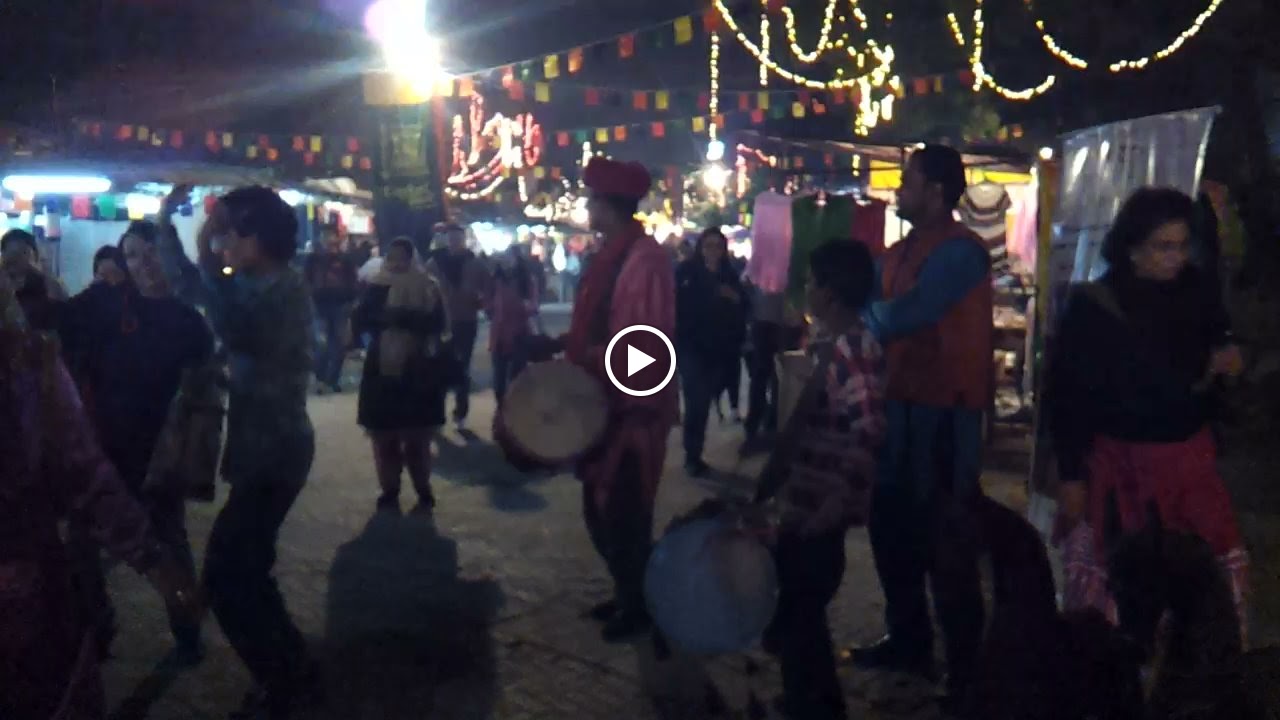
The scene right before our departure at Dilli Haat. Punjabi drummers and music encouraged audience members (including my friend Michele) to dance with them!

Two Punjabi dancers in traditional dress at Dilli Haat

We left Dilli Haat, pulsing to the beat of Punjabi drums accompanying a pair of gyrating Punjabi dancers in purple, and headed to dinner. The restaurant, Evergreen, is in a nicer shopping district (remember, even if I say “nice,” things are still dusty, there is still trash, there are still some decrepit buildings around, etc.), and its four floors of dining rooms grew up over time from its first-floor sweets and snack shop. There we dined on chaat, plates of snacks that are honestly difficult for me to describe. I specifically remember liking one that had fried dumplings covered in yogurt and a slightly sweet, tangy sauce with something kind of crunchy on top. There was another plate that had popped rice mixed with peanuts and diced tomato and some other stuff. Then dinner included rice and paneer and some kind of curry. My boyfriend has taught me to love paneer, which is basically blocks of really mild cheese that take on the flavor of whatever is put with it. I have to be careful to not always order paneer every time I eat at a restaurant. I enjoyed getting to talk to Nicole, Pam, Emily and Archna-ji about their lives and Archna-ji's arranged marriage to Goutam-ji. They were married about a decade ago, and they saw each other only twice, I think, before they were married. Someone's cousin was the sister of someone's aunt, and they were matched together because people thought their personalities would work well together (and as far as I know, they were right). They both had to be Brahmin, but they could not come from the same family group, so it was a good thing that Archna-ji came from Jaipur and Goutam-ji came from Varanasi. I believe that Goutam-ji is of a slightly higher jati than Archna-ji, but I don't really know how that plays out.

The yogurt-and-dumplings-and-tangy sauce chaat
The popped-rice-and-other-stuff chaat
The I-dunno-what-was-in-this-but-it-was-good chaat

Paneer masala, rice, garlic naan and curry for our main dish
Fried dough (maybe chick-pea flour?) dipped in honey or some kind of sugary syrup. YUM!
Just to give you an idea of where we ate
I came home that night and started composing my first blog entry. My mind was so full of new knowledge and wonder and questions and connections and insight. I just felt overwhelmed, and I was asking myself, “How in the world is my mind going to be able to process anything at this rate?” And then classes started.

By “classes,” I don't mean traditional lecture classes. At any given point we were either listening to a speaker discuss his or her organization/cause/theory of social entrepreneurship or social change, or we were asking questions to that person about their organization/cause/theory, or we were discussing said organization/cause/theory as a group. Many of those group discussions happened on the bus in between sessions with speakers, because that was the only time we really had with our incredibly packed schedule to synthesize our learning. We started every morning around 9ish, breaking for lunch from 1pm-2pm (sometimes we had lunch speakers), and then we would continue until 4pm at the earliest, ending at 7pm one night (I think we heard from four organizations that day). We met some of the most amazing, most inspiring Indian change-makers, who believe firmly in their country's potential and who are unwilling to give up on their goals despite the huge obstacles they face in terms of government inaction/obstruction/corruption/unwillingness, societal norms/expectations/customs/traditions/diversity/disunity, economic disparity and population. For the purpose of not completely overdoing it in one blog post, I will save my descriptions of each person/organization in my next blog (which I have already started). I'll conclude this post by saying that I am truly grateful for having had the opportunity to begin my four-month adventure in India with these two courses, and the groundwork has been laid for me to maximize my time here working in development.

In the meantime, I am staying at the SIT Delhi Center completing a UT Distance Ed class in Microeconomics and writing papers for each of my SIT courses. Dr. Azim Khan, the director of SIT Delhi and SIT India, graciously offered me room and board here at the center while I tie up loose ends. When I have finished, I will begin working for Dr. Azim. He and his colleagues here at SIT Delhi established the Foundation for Public Health, Education and Development (FPHED) to address development needs in Dr. Azim's home village of Bahraich, UP. They have started the Global School of Learning (GSL) there, so I will be working some to update publications on that. But I will also be heavily involved with the conduction and analysis of FPHED's first baseline health survey, and I am really excited about that! I will tell you more about FPHED and GSL as I get started :)

Śānti,

Ellie

Wednesday, January 22, 2014

Finally here!

 I feel like I have learned so much in the past 37 hours; my mind is completely exhausted, and we haven't even started classes yet.

I arrived here in Delhi at 12:30am on January 11th after about 23 hours in transit. Before, during and after that flight from Amsterdam, I was already beginning to see signs here and there that told me I was certainly heading for somewhere completely different from the United States—Hindi, Sikh turbans, head wags, long dresses, slight pushiness were all present on the 7ish hour plane ride here. After immigration I headed for the baggage claim. As I normally would in the U.S., I stood back a few feet from the carousel in order to be able to see aways down the belt so I could anticipate my bag's arrival. This worked out fine for a moment, but considering that I had flown in with the rest of my 747, the space between myself and the carousel was quickly swallowed up by men who were taller than me. Although I immediately felt a little offended by these people's lack of disregard for myself, I silently reminded myself that 1) getting my bag quickly didn't matter in the slightest since I knew I would be waiting for another fellow SIT student to arrive after me, and 2) I was entering a new country with completely different ways, so I just needed to chill out and observe. Now, after more opportunity to observe, I am starting to realize that when you live in a country with literally a billion other people, you do push to get what you need, or else you won't get it.


After collecting my luggage, I realized that I had no idea how to meet up with the two other students who were arriving in my same time bracket, and that I had no idea how to identify my ride (and that I should have gone to the bathroom before getting my bag—duh Ellie). I saw the mass of chauffeurs waiting outside of customs and decided I didn't want to spend my first few minutes staring at each of the hundred signs trying to find one that, for all I knew, didn't exist. I walked past and scanned the people hanging out around the waiting area for people who didn't fit in. As I spotted a possible outcast like myself, Champa came up to me with an SIT World Learning sign and escorted me over to the very woman I had spotted (sidenote: outcast, for those of you like me who had never really thought about the origin of this word, literally comes from being outside of the cast, or at the very very bottom of society, like the Dalit Untouchables here). While Champa, a quiet but very kind man who works in some still-unidentified way for SIT, waited for the third student of our time slot to arrive, I got to spend time getting to know Jamie. Jamie is a student at SIT Vermont in her thirties who is currently doing some type of interdisciplinary master's that I can't remember right now. Most importantly, we connected on all kinds of topics that got me pretty excited about the Sustainable Development classes we are starting tomorrow. I felt reassured that I was doing the right thing for myself and my career (and that feeling hasn't subsided!).

Around 4am (a few hours behind schedule), Michelle rolled out of customs with two bags, looking anxious. She had spent the past 2 ½ hours looking for/dealing with her third lost bag (she is during her practicum in Ahmadabad after we finish up our courses, so she brought the whole kit and caboodle). She had finally resigned herself to giving the airline the information we had about where we were supposed to stay, so we were ready to go... until we got out to where our driver would pick us up, when Michelle panicked and ran away from us, saying something about “I lost my book.” She hadn't made it clear to us that her travel documents were in that book, which she thought she had mistakenly placed in her luggage cart and left behind as we crossed the street. As we ran around searching for Michelle's pink book, it was hitting me that, holy crap, I was in INDIA. People didn't speak English, the security guards were fiercely guarding the door, taxi drivers and auto-rickshaw drivers were trying to get us into their cars, and Michelle's travel documents were most probably long gone in this chaos. She checked her bags again annnnd found her book and everything she needed. I suppose I could have gotten upset about this, but I am finding that more and more I like to congratulate myself when I think I have lost something and it turns out to be exactly where it was supposed to be. I feel happier that way :)

We took the half-hour car ride alongside horse-drawn carts. Maybe it was my post-travel fatigue, but I felt like these heavily shawled and layered cart-drivers making their way into Delhi through the fog were somehow linked to Sharazad, like they had just made an immense trek across far away lands. The galloping Palamino reinforced this image in my head. We arrived at our hotel in Jasola Pocket-2, which is a gated community in the midst of a lot (like a LOT) of poverty, aside from the manicured basketball courts and cricket fields across the street. We are staying in an extension of the Blue Moon Hotel, because I guess there wasn't as much room as was initially thought at the Blue Moon, which is also in Pocket-2. As in teaching, flexibility seems to be the name of the game here in India.

Champa-gi led us inside to hotel, and we assumed we would be told where our pre-assigned roommates were placed so we could go crash in our beds. You think you'd have an easy time in India? Haha not so fast! Lots of Hindi was spoken amongst the hotel men, and never were we able to make clear to the men (who had been sleeping on mats on the floor before our arrival) that we just needed to know where our particular roommates were. Even with the sleepy help of Claire, another SIT student, who came out of her first-floor room to try to ameliorate the situation, we never were able to completely understand why there wasn't enough room in that building. Jamie and I ended up being taken down the street about 70 yards to the actual SIT center, where there happened to be an extra empty bedroom. At 5am, I plopped down on the (super hard) bed and tried to go to sleep. Even inside my sleeping bag I had brought along (like totally inside, with part of it over my head and the opening completely closed shut by my fisted hands) and the provided blanket, I was super cold. Delhi is cold in January. So weird.

Jamie and I woke up around 9:30am and were met by Suleman, the shy, quiet chai-wallah of SIT. He is probably a little younger than myself, and works in the kitchen and brings people chai (they drink upwards of 10 cups of chai a day!). He made us breakfast that morning (toast, chai, peanut butter and crackers) before we went back to the hotel to go to our real rooms. I asked him why everyone seemed to be referring to each other as something-”ji,” like Champa-ji, Abit-ji, Ellie-ji, etc. Suleman explained that “-ji” is a sign of respect for people. I decided immediately that I loved this, and the first time I made contact with my family and boyfriend, I informed them that they had now attained the “-ji” title in my book (Mama-ji, Daddy-ji, etc., or, for my boyfriend, Louis-ji haha). Everyone in SIT now enjoys calling each other using “-ji.”

Around 10 or so, Jamie and I headed down the road back to the hotel, where we were shown to our rooms where our roommates were waiting, as expected! After meeting my really friendly, 22-year old roommate Brittany (a recent University of Vermont graduate who is in the Sustainable Development Master's program at SIT Vermont) and setting my things down, I finally got to take a hot shower (there is a pretty dependable hot water heater that you have to turn on 10 or 15 minutes before your shower). The bathroom was all granite, but it had absolutely no divider between shower and the rest of the room. I've noticed that there is a big bucket and smaller cup in every bathroom I go in here in India, mostly placed in the shower, but often just in the bathroom area. I've also noticed that there is always a shower hose and head next to the toilets. I've been using the bucket for laundry, but I'm pretty sure I could benefit from a step-by-step explanation of exactly how these unfamiliar bathroom tools are used. But somehow I doubt I'll work up the courage to ask an Indian woman to explain it all in the amount of detail I actually want, nor will I find an Indian woman actually willing to explain such private (and probably very obvious) things to me.

Somewhere in the whole process of getting ready to go exploring with other SIT women, I stepped out onto our 4th floor balcony to take in the view (and smell). Across the little street, still within the confines of Pocket-2, another four-story apartment building is under construction. All around it was scaffolding made of lashed-together bamboo poles that looked like it wouldn't be up to any American code, but seemed to be functioning just fine. I admired the unassuming bravery of the men who, sans safety gear, balanced themselves on 2x4s laid on the bamboo scaffolding and put together this new building in beautiful fashion. Turns out these construction workers and their families live in the buildings they work on until the building is done, after which they move on to the next building they construct. Each night we saw and smelled the fires of this community, made up of a particular caste who is fairly destined to spend their lives, generation to generation, living this life. Being in a big city like Delhi, there is a certain amount of social mobility and a small possibility of a different life if so desired. However even in Delhi the caste system is alive and well, as I will discuss in my next entry (and I wouldn't be surprised if it is a continuing theme in my blog, since the caste system is a cause of many human rights violations here in India).
The building under construction across the alley from us, complete with construction worker residents and bamboo scaffolding
Our friendly neighbors!


Another thing I noticed from the balcony was a particularly horrible smell that made its way to my nostrils amongst all the other crazy smells of India. Just to the left of the partially-constructed building is a plot of street land entirely dedicated to the drying out of flattened water buffalo patties, that are sold and used for fuel. It's certainly a resourceful use of cattle dung, but good god it smells bad, especially when it's lit on fire. In fact, I have been reminded of Central America a few times, although it's far more powerful here, of burning trash and feces. Lovely (to the point of making me gag).

Water buffalo dung being dried out between the street and our gated neighborhood. Smells lovely. Not.

The nine students who had arrived and were staying at 19 Pocket-2 (as opposed to Blue Moon) took a quick stroll around Jasola. Jasola Village is really poor, but it's not a slum. There is trash everywhere, along with cows, pigs, people on motorcycles, people driving rickshaws (both motorized and bicycle-propelled), standing water, zero sidewalks, and more trash. I guess it's honestly hard to describe, because there is absolutely nowhere in the U.S. that looks like this that I have seen. Our large group of foreigners in western clothes attracted blatant stares, which is to be expected (and I had read about it in Lonely Planet on the plane ride over). We walked past the “hospital” and the “pharmacy” (I have been warned not to use these places for my medical needs) over to the “mall,” which is really just a whole bunch of little stalls all piled on top of each other, but what else is a mall other than that, really? There is a liquor store at the mall, but I would only go there during the day and/or with a group, since women who drink attract a certain amount of attention here. If I was in a group I would certainly feel safe, though. On the way out of the mall, a boy of about 6 latched on to me and begged for money from me for about 100 feet. I ignored him, talking to my new peers, until the corner, when I gently pushed him away. That was the first encounter of tons of heartbreaking requests for money, either through sales of cheap materials or through begging. Goutam-gi, one of the Hindi teachers and Academic Coordinator-types for SIT, when asked how he decides to whom to give, responded with this: “When my heart sees it, I give. The eyes, they see, but other parts of our body also see. When you close your eyes and touch a knife, your fingers see that it is sharp. Just like this, you can close your eyes and your heart will see the truth. When my heart sees that I need to give, I give. With my eyes I am blind, and in that way I can be cold to people.” I thought this was a beautiful way of helping me understand that I will know when to give and when not to give.
A typical, absolutely delicious dinner thanks to Champala and Suleman- dalh, curry, veggies (that we can actually eat because we know that the knives that cut it are clean) and roti
After our first lunch of many delicious lunches at SIT Delhi, made by Champa and Suleman (who know, after I told them, that I hate cilantro, which they call coriander, and who have made separate coriander-free dishes for me whenever the group dish has coriander in it! So nice and yummy!), five of us headed into town on the Metro. We paid Rs 10 (which means 10 rupees) apiece to take a motorized rickshaw over to the Jasola-Apollo Metro Station. We later learned that only four people should take a rickshaw at a time, since having the fifth person sit up front next to the driver can throw the balance of the rickshaw off. Not knowing this at the time, I climbed in next to the driver and off we went.

As we were studying the map, trying to figure out how to get to Rajiv Chowk as per Lori's directions from one of our coordinators, I noticed that all of the Metro stations that started with M had the same Hindi letter, since they had both the Hindi and English spellings on the map. I decided, in the style of Sesame Street, that my letter of the day would be M. I spent all day looking for this letter, and was particularly happy when a sign for a Hindi-named place would have both the English and Hindi spellings. I am going to continue Sesame Streeting Hindi for awhile :)

Manual Hindi
We bought our Metro coins, which are little plastic coins with some kind of chip inside that has the amount of money you need for your trip on it. You scan them as you enter the Metro, then you go through security (which is separate for men and women), you take the Metro, then you deposit your coin on the way out as you walk through the turnstyles. The great thing about actually taking the Metro, though, is the Women's Only car—it makes me happy just thinking about it! The last car of each Metro train is identified by two large pink signs hanging from the ceiling that declares in white English and Hindi script Women Only. Obviously men aren't allowed on this car, and it smells better and feels cleaner than other cars. When men (usually teenagers) try to get on, whether by accident or on purpose, they are immediately told by the women on the train to move to the next car. If they slow down in their journey, they are again told to move on to the male car. It is so awesome to watch, and there is this great camaraderie that exists there, alongside a certain feeling of relief and respite.

We took the violet Metro line all the way to its final station, Central Secretariat, a major hub full of people, where we changed to the yellow line. We took that two more stops and got off at Rajiv Chowk, which is where Connaught Place is located. We were swept up in the mass of people that make up the mid-afternoon crowd (which, as I would later find out, is nothing compared to the 7:30pm crowd). As some of my friends got coffee (including a “vegan shake” which was actually just coffee with ice and way too much in the way of sugar crystals), I went in search of Metro maps. I noticed, waiting in line, that no one was waiting in line. In fact, there was no line besides me. So I decided to do as the Indians do and simply assert myself. Although there were two people discussing something through the hole in the glass with the Metro employee, I snaked my arms through them and the hole in the glass and grabbed five Metro maps. No one reacted at all. This is now my modus operandi, just getting what I need when I need it without thinking about letting order have its way, and it is working really well for me. I guess it's actually just a different definition of order if you think about it.

Connaught Place, which is right above Rajiv Chowk, is a big circle that surrounds a park. The whole thing is, of course, is full of people, and many of them seemed interested in us. We had several men approach our group of five women and offer directions, ask if we needed anything, follow us around, what have you. None of it was particularly welcome, but none of it was harmful. We wandered around the park area, through the cheap open-air markets selling western item that didn't interest us, and finally ended up at this little exhibition that was elevaetd above street level in the park, and it was to educate Delhiites about the nomadic tribes of neighboring Rajasthan. They had handcrafts, including beautiful pouches (Brittany bought one), food (I bought some fresh masala chai, made right in front of me from scratch, that was absolutely delicious), and musical instruments. A woman who seemed to be running things came up beside Brittany and me, the only westerners around because our other friends had gone to sit in the grass and talk to little girls who were selling pens (under the creepy gaze of a man who we think was basically pimping them). She told us that the government was sponsoring the exhibition to promote the nomadic traditions, and also that these people could make money by creating their traditional handcrafts rather than moving into call-center type jobs. She explained that the instruments were healing instruments that are played near your heart and that make a particular tone that is good for you, and she recommended 15 minutes a day of playing. We then watched and listened as the woman and a few other people, including a traditionally dressed Rajasthani nomadic man, played a few songs that were unlike anything I've ever heard. I loved it! After the music, a man who was working at the exhibition came up to Brittany and me and offered us a roti (flat bread like naan, but rougher) that was made with special grains from Rajasthan that had spicy oil on it. Yum!
Connaught Place is FULL of people! 

The little girl at Connaught Place taking a break from selling pens to play with the Rajasthani nomadic healing instruments

We got to hear traditional music as part of the exhibition on Rajasthani nomadic tribes
We started making our way towards the Gate of India, which turned out was quite the walk. We could have paid a few rupees to take an auto-rickshaw, but we opted to walk to see more of the city. I really enjoyed the upscale neighborhood through which we walked, which had big green trees overlooking walled-in condos and centers of commerce and learning. The fog that possesses Delhi throughout the winter started to settle as the afternoon passed, giving the area an enchanted look that fascinated me. When we finally made it to the Gate of India (which I honestly know nothing about, having simply followed the leadership of one of my peers), we found out that it had closed about an hour before. Oh well! We made our way back to the nearest Metro and found our way back to 19 Pocket-2 Jasola. After a the internet finally gave out for the night, I fell asleep ready for the next day's SIT Delhi Orientation. I was excited to really get the learning started!

I'll try to be more succinct in coming emails. I'd love to hear thoughts, questions and reflections as I go along my journey! 

Śānti (peace),
Ellie